The gold beyond the dragon: How I faced my complex fears for Cape Verde
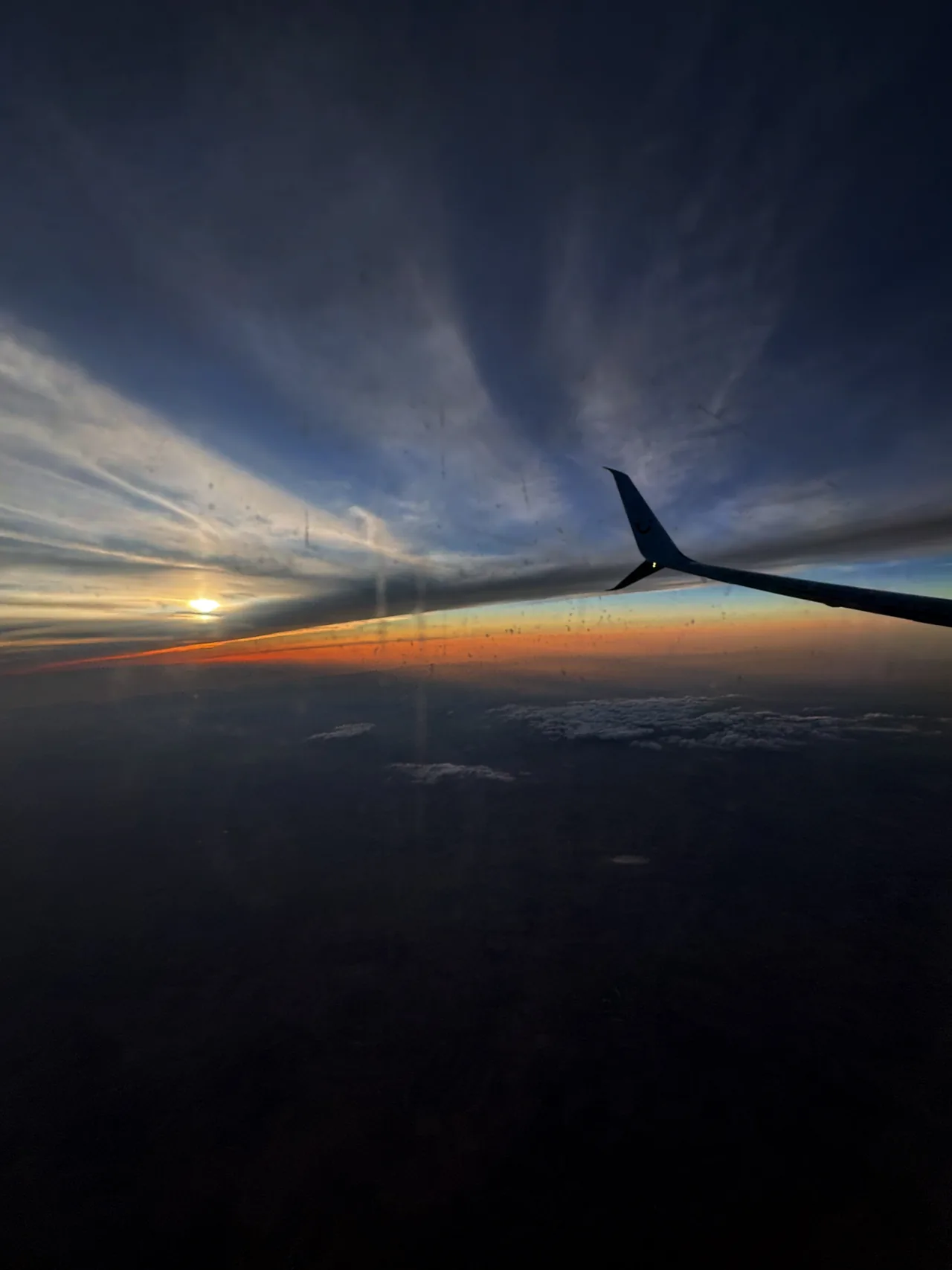
Charlotte and I went to Cape Verde. Eight hours on the plane on the way there, six on the way back. Flying to Calpe in May had already been a huge victory. This was a different story altogether.
I'm not afraid the plane will crash. My fear is mostly about lots of people in a small space. I could happily go caving, for example, as long as it wasn't with a group. Put me on a plane around the world on my own: no problem either. Add lots of people and my body goes haywire. An unbelievable amount of tension. I can even have that in a restaurant. Or in a bar. Or at a garden party with lots of people...
Then there's paruresis, a fear of urinating around others. By now, it's also become a fear of the fear itself. I'm noticing that it's many things together. My fear doesn't have one clear object, like a spider. What I experience is complex and difficult to tackle. Take away that fear of flying and something else will take its place. It feels as though there's some sort of PTSD underneath it, which can show itself in all kinds of ways.
During our trip to Cape Verde, a good friend told me how much he respected the fact that I face those fears anyway. He asked how I did it, because he too has a great fear of planes. So I'm going to try to explain how I do it.
I want to say the most important thing first: you do not have to overcome your fears. If you're afraid of going on a spacewalk, for example, that's probably a fear you can happily go on living with. You don't necessarily have to overcome your fear of a plane either. You can just go on holiday by car. For me, travelling is more about the company than the destination. I know other people really want to get to know other cultures. It's different for me.
Above all, I don't want my fears to get in my way. Strangely enough, for me it's often about the fear itself. I can't stand it being there. Now that I've largely overcome my fear of performing, for example, I'm starting to wonder whether I actually enjoy performing... And after a trip like Cape Verde, I often hit a low for a while. Because all of it should really be normal. In my head, anyway. Something like that...
What helps me most in facing a fear is knowing what the harvest will be. What gold lies beyond the dragon? How much do you want what's on the other side of that fear?
For example, I've been asked to fly to India for work. I can't manage that, because that trip doesn't offer me enough personally to face all that fear. Performing is worth the effort for me, even if I sometimes question it. And flying is too, if a trip I truly long for is waiting for me.
Calpe was wonderful. In two and a half hours, we were 1,410 kilometres away. As the crow flies. By car, that would be about 1,800 kilometres and eighteen hours of driving... I even like being on a plane. I love it when that thing takes off. The power, the acceleration. Wonderful. So yes, the most important thing is the harvest.
I spent a long time in therapy with a behavioural therapist I think very highly of. That's where I learned about gradual exposure: seeking out things that bring on the fear, with the volume turned down a little.
For me, a sweat lodge has something in common with a plane, for instance. You're with people in a small space. There's one important difference: if I really can't cope, I can get out. There is some group pressure, and still I can get out. On a plane, of course, I can't.
So I started taking part in sweat lodges. I'm still afraid of them. Little by little, I've learned to stay with that fear. Sometimes I can, sometimes I can't. That has been my personal path, not an exercise that's suitable for everyone.
In some sweat lodges, I even made myself go outside after every round. Just to teach myself that I'm allowed to. That it's my life and I get to decide. With respect for the ceremony, of course. Even with all the traditions and rules, I'm still allowed to choose myself and step out of something. That was very important to me.
Maybe not all of that relates directly to the plane. But I think these are patterns I can work with. Learning to love yourself. Being gentle with yourself. It's okay to be scared in a sweat lodge like that. It's okay to be scared on a plane. Don't be too fucking hard on yourself.
The next thing for me is making sure I'm as strong as possible beforehand, physically and mentally. Prepared. Over the last few years, for example, I've learned what breathing exercises can do for me.
At the moment, I use two approaches. I find the first on the YouTube channel BreathworkBeats. My favourite is this breathing exercise, and there are others. What I notice most is that breathwork can help me lower my tension.
My second exercise is the Osho Chakra Breathing Meditation. I don't believe in chakras. I do like this exercise. Sometimes I think Osho mainly wants to get you breathing for 45 minutes first, so that afterwards you can finally meditate for fifteen minutes. That's how it feels to me, anyway.
I haven't found a really good instructional video yet. This one is the best I've found so far. You can find the meditation's 'music' here. If you'd prefer the separate phases, you can go here.
Last year, before going on a skiing holiday with my daughters, I did that Osho meditation for a hundred days in a row. I felt it helped me get my baseline tension as low as possible. That's mainly what the breathing is about for me. My baseline tension is usually very high. If I want to do something very frightening, I want to start that adventure as relaxed as possible.
Exercise is important to me too, so that my fitness is okay. Fear asks a lot of the body. Being in good shape helps me carry that. For me, that's CrossFit, stretching and early-morning exercises.
For stretching, I've been returning to three videos for a long time. Two are by BodyweightWarrior: this one and this one. I also often do this session by Caitlin K'eli Yoga. And for the morning, there are these exercises by Jules Horn.
The next thing may well be the most important of all: having someone with me who is there for me unconditionally. The way most parents are there for their children. I don't find it easy to believe someone will be there for me like that. When two fathers have abandoned you, you no longer believe that so easily.
So the company is enormously important. Will you be there for me, whatever happens? If I have a panic attack. If I can't pee. If I become terribly frightened beforehand.
That person doesn't need to rescue me or feel sorry for me. Someone who stays practical helps me most. As in: 'Okay, this is the problem now. What can we do?' Standing beside me. Being there when needed. And of course, carrying each other a little from time to time is absolutely okay too.
And then something I'm not at all ashamed of: medication.
For Calpe and Cape Verde, I discussed this with my GP. Everything I've described above helps me need as little medication as possible. I used to have to take a lot to be able to travel, even by car. Afterwards, I had to go through withdrawal every time. That was far from pleasant.
On those flights, I used the beta blocker propranolol, among other things. In my experience, it doesn't take away my anxious thoughts, but it can temper the physical agitation. That makes a difference for me. When my heart starts racing, I become afraid of that racing heart. Then the fear gets even bigger and everything reinforces itself.
I also took propranolol once before a performance. I didn't think that was a good idea: on stage, that adrenaline, that heartbeat, that tension are actually useful to me. So what helps me with one thing doesn't necessarily work for another.
For the flights, I also used Valium and Temesta, as discussed with my GP. For Calpe, I took Valium the evening before as well. Boarding is a particularly tense moment for me. That baseline tension plays a part here too. Fear sometimes feels like a bucket gradually filling up. I try to keep it from overflowing, because in the middle of a panic attack it's much harder to find calm again.
I'm deliberately leaving out the exact doses and timings here. What I'm describing is my experience, not a schedule to copy. Which medication, how much and in what combination: that's something to discuss with your doctor. Whatever else you're already taking belongs in that conversation too. Valium and Temesta can intensify each other's sedating effects. Alcohol has no place in that combination.
For me, it's important that a doctor takes my fear seriously and makes a plan with me. That also includes clear agreements about the amount I'm given. Not starting to take more on my own in a panic. And of course, making sure beforehand that there's enough for the return journey too.
For Cape Verde, I gave my girlfriend a backup supply. If I were to lose my medication for the return journey, that would be a real problem for me. I don't know whether I'd board the plane home without that reassurance.
Important: Valium and Temesta can cause dependence, and tapering off can be difficult. I've experienced that myself. Even using them for a flight is not automatically risk-free. That's why I think it's important to agree on this with my doctor.
Even after seven years of working so hard on myself, after all the exercises, body-oriented therapy and ceremonies, peyote, kambo, magic mushrooms... I still need medication for such a long flight. Maybe that will be different after another ten flights. We'll see. I'm not turning it into a battle either. My body is full of trauma and tension. With that medication, I feel normal for a while and I manage to use the toilet on a plane.
Catheter. Wow.
So I have paruresis. And it's not 'just in my head'. Well. What I mean is: in certain situations, my body goes into a kind of fight-or-flight mode, which means I can't pee. I've written other blog posts about that, so I won't go into it in detail here.
For me, it was important to have a last resort. What if I really, really, really couldn't pee on that plane? Not even if it was desperately urgent? Because that genuinely does happen in those situations.
I contacted a urologist and learned to catheterise under supervision. It took two years before I could do it. I found it terrifying. That tube going so far inside... Crazy. And then past that sphincter as well, while my whole body is tense.
What I mainly want to acknowledge here is courage. The courage to tackle something that terrifies you. Your fear may, of course, be completely different. If you're afraid the plane will crash, I don't have a ready-made answer for that either. Rational words often aren't enough to reassure a body.
When I finally managed to catheterise, it was a eureka moment for me. As in: 'Now I'm getting on that plane. If I really need it, I have a way out.' Something clicked then. On the four flights to and from Calpe and Cape Verde, I ended up not needing that catheter. Sometimes the idea that there is a solution helps more than the solution itself, I suspect.
So. Fears...
It takes a lot of courage and willpower to face them. And perhaps you don't have to overcome all of them either. Often, though, the gold beyond the dragon is worth it.
My body suffered enormously before Cape Verde. All kinds of things were happening beneath the surface. Bruxism at night, leaving my jaws completely clenched. Toothache and neck pain as a result. In the week before we left, I went to the osteopath three times and to the dentist once. For me, that's also about knowing myself and looking after myself. Doing everything within my possibilities to make that trip work.
That's frustrating sometimes. Someone else can go out, drink and smoke the week before, and then sleep and recover for eight hours on the plane... Things are what they are.
I've found a lot of gold beyond my fears. Gold in performing. Gold in my singing circles. Gold in training to become a body-oriented therapist. Gold in my career change to Team Lead. Gold in that beautiful trip to Cape Verde with my love.
The gold I still have to find now lies in relaxing, resting and learning to do nothing.
Thx for listening!
Greetz, Lieven
P.S. The Tools. A wonderful book by Phil Stutz and Barry Michels. One of the things it explains is the reversal of desire. Wanting to face your fears. That idea appeals to me: there can be opportunities to grow too. In a smart way, though. Read the book ;-). A documentary about Stutz was also made for Netflix. No idea whether it's still on there. You'll find it somewhere.
Good luck!